
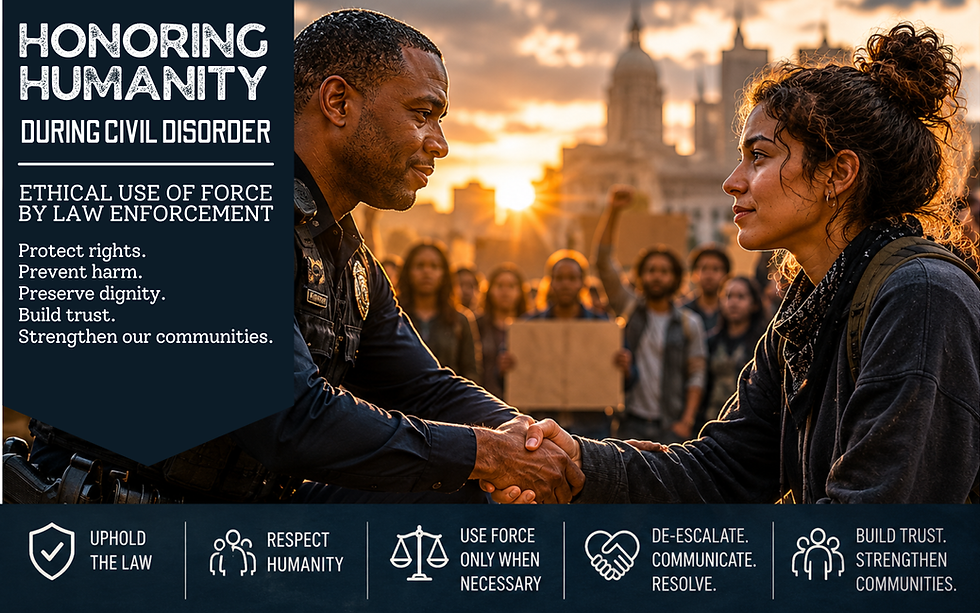
Honoring Humanity During Civil Disorder:

Ethical Use of Force by Law Enforcement
By Richard Mathewson
© 2026
The Kincade Society
ALL RIGHTS RESERVED
ABSTRACT
The First Amendment right to assemble is fundamental to citizen participation in this Constitutional Republic. This right empowers the citizens because it gives them voice in the shared society in which they live. For this reason, it must be cherished and treated as sacred by government authorities responsible for preserving and protecting the welfare of the citizens. But with every freedom comes responsibility. No one has a right to engage in conduct that enacts violence or harm against another, even when they are exercising other lawful rights. When violence occurs, there must be a mechanism whereby harm can be prevented and the innocent protected—in America, law enforcement fills this role. Law enforcement is the first line of defense in the American system—it is the shield and sword that serves and protects the public. When the right to protest becomes civil disorder, law enforcement will get involved to uphold order and ensure a civil society. This may include use of force, and in this situation conflict is inevitable. But to achieve the goal of conflict resolution versus escalation, use of force must be implemented ethically. Without ethical use of force, law enforcement will only contribute to conflict, not mitigate it. This paper focuses on the ethical use of force by law enforcement relating to civil disorder. It examines the intersection between the right to protest, the laws that control use of force, and the humanitarian concerns inherent in situations involving citizen protest and law enforcement. This follows the Ethical Use of Force Program offered by The Kincade Society with the goal of ethical enhancement, risk reduction, and improved community relations in the context of law enforcement. In a time of increasing civil unrest, this paper is a clarion call to law enforcement to remember their oath to serve and protect by honoring the humanity in the citizenry with which it engages especially during civil disorder.
INTRODUCTION
Ethical use of force seems like an oxymoron. How could using force against another human being ever be considered ethical? This question becomes more complicated when used in the context of the First Amendment exercise of the right to protest. This is a fundamental right protected by law. But this question is meaningful because it affects everyday citizens who wish to publicly express their grievances regarding matters that impact their daily lives. In a Constitutional Republic that America is, upholding a citizen’s right is paramount because it ensures continuity of the liberties the Constitution provides. However, when that citizen deviates from conduct protected by that right and engages in unlawful conduct that involves violence or harm to others, force may be the only appropriate means by which to protect other citizens.
The American system provides a uniquely expansive range of freedoms and liberties to its citizens, but this comes with a caveat. Each freedom comes with responsibility to use that freedom in a way that ensures domestic tranquility and does not violate laws or infringe on others. The American way only works when everyone contributes by upholding its ordering laws—especially law enforcement. This echoes in the Preamble to the U.S. Constitution that calls the citizen into this shared responsibility:
We the People of the United States, in order to form a more perfect Union, establish justice, insure domestic tranquility, provide for the common defense, promote the general welfare, and secure the blessings of liberty to ourselves and our posterity, do ordain and establish this Constitution for the United States of America.1
Nevertheless, no society exists free of lawbreakers. Because there are always those who engage in violence and harm against others despite the fact that the majority of others are peacefully protesting, there must be a means by which these outliers can be legally constrained. In America, the means of constraint is by the operation of law. And the government is tasked with upholding these laws—through law enforcement. But this requires a citizenry that accepts this dynamic and respects its wisdom. For this to work, law enforcement is necessary but for law enforcement to achieve its ends of upholding law and order, it must conduct its duties in an ethical way and treat citizens as human beings. If it does not, the citizens will not respect its institution.
John Jay, a framer of the Constitution, wrote about the necessity of a governing authority in The Federalist No. 2:
Nothing is more certain than the indispensable necessity of government, and it is equally undeniable, that whenever and however it is instituted, the people must cede to it some of their natural rights in order to vest it with requisite powers.2
But government power is not unlimited—even the government is constrained by the Constitution. This truth was reflected by Supreme Court Chief Justice Marshall in an early seminal constitutional law case on the limits of governmental power:
We admit, as all must admit, that the powers of the government are limited, and that its limits are not to be transcended.3
The limiting power concerning law enforcement is the Constitution. Where the Constitution provides for law enforcement to keep the peace and ensure order, it contemporaneously prohibits abuse of force by law enforcement when carrying out these duties. And where the same Constitution protects the citizens’ right to protest, it simultaneously prohibits violence and harm during the protest. In this sense, law enforcement is, by extension, a creature of necessity, and it was intended to preserve Constitutional rights, not violate them.
In its support of government functions, law enforcement is a necessary part of American society to the degree it enforces the laws that uphold order and ensure tranquility. But law enforcement itself is constrained by law and must not step outside its dictates when engaging in its law enforcement activities. As with any social contract, the parties must accept its terms and abide by them or risk the penalties of noncompliance. Here, with the First Amendment right to protest, citizens who exercise this right must not step outside the confines of the law. They must engage in this exercise lawfully and avoid acting violently or harming others. In a situation where this happens, and assuming law enforcement does their duty to serve and protect lawful protest, the American experiment is successful. But citizens who engage in violence or harmful behavior towards others during the exercise of their right to protest subject themselves to possible use of force by law enforcement.
But this paper is not about the lawful conduct of citizens during protest or their required compliance with the law. Instead, the focus is on the expectation of law enforcement to act ethically in its conduct when confronting civil disorder. Law enforcement has a uniquely powerful role in society because it has the authority to deprive citizens not only of their freedom, but of their life, and this under the color of law. This power disparity alone in a society “of the people, by the people, for the people”4 requires a higher level of ethical competence. The onus, then, is on law enforcement to act ethically in their duties, especially when using force.
In short, in situations where law enforcement must use force to suppress violence to prevent harm to others, they must do so ethically. Because their purpose is to uphold the law, not doing so is a gross miscarriage of justice. If they abuse this sacred call to protect and serve the citizens, law enforcement fails to uphold the American ideal. This paper examines the interplay between the citizens’ right to protest, lawful use of force when responding to unlawful conduct during a protest, and the advantages of ethical use of force by law enforcement. In this Constitutional Republic, citizens have a responsibility to adhere to the law when exercising their rights. But law enforcement, because of their position of power, has a civic duty to their community and their nation to not abuse their authority when dealing with the public. Any use of force against a citizen must be lawful and ethical. Anything less is unacceptable and only further erodes confidence in the American ideal. For this, law enforcement must learn to see the human in the protestor, no matter how that protestor is acting.
This paper is based on the Ethical Use of Force Program offered by The Kincade Society. The Kincade Society does not teach use of force per se, as this is already covered in law enforcement policies and training programs at each department or agency, but it consults with law enforcement on ethical enhancement of their current use of force policies and practices. There is renewed focus on police practices and community interrelations in our time now. This program bridges the gap between outdated practices from a bygone era and current changes in society necessitating an upgrade in how law enforcement implements use of force in its line of work. The benefits include ethical enhancement, risk reduction, and improved community relations. This consulting is multifaceted, combining an intimate knowledge of the mechanics of power, law, human behavior, belief frameworks, and institutional dynamics. Note: The information in this paper is provided for general informational or educational purposes only and does not constitute legal advice.
THE FIRST AMENDMENT RIGHT TO PROTEST
To enforce the law ethically, law enforcement must first understand the importance of the laws they uphold and the relevance of those laws to a healthy functioning society. The right to protest has a special place in the constitutional scheme. The U.S. Constitution put special emphasis on this right evidenced by its placement at the front of the Bill of Rights. This is because a nation cannot be “free” unless it has the freedom to openly and lawfully confront its own government. Without the ability to freely express itself, a citizenry is slave to the power that governs it. The framers knew this and included this protection of liberty in the First Amendment:
Congress shall make no law respecting an establishment of religion, or prohibiting the free exercise thereof; or abridging the freedom of speech, or of the press; or the right of the people peaceably to assemble, and to petition the Government for a redress of grievances.5
But this right was not just about countering tyranny. It also serves a psychological purpose: it gives the citizens voice. When someone feels unheard, when they are unable to speak their truth, they become resentful, frustrated, angry, even vengeful. This leads to acting out these pent-up emotions, which translates into aggressive or violent behavior. Being able to articulate these emotions, on the other hand, enables a more adaptive way of expressing oneself. The freedom of lawful expression protected by the First Amendment, then, is therapeutic because it provides a healthy outlet for the citizens. Instead of rioting and destroying things, they walk and purge their frustration through voice. Law enforcement should help guide this process, not inhibit it.
Thus, the First Amendment sets the standard by protecting the citizens’ right of expression so long as it is done peaceably and lawfully. This is essential to our Constitutional Republic because without the right to assemble and petition the Government, it cannot be said that the Government represents the will of the people from which it derives its power. Because the people influence policy and law through their government representatives, and because protesting is one important way of signaling support for or dislike of a policy or law that will affect the people, allowing the citizens to lawfully protest is fundamental to the republic. Both the political and psychological benefits of freedom to peaceably assemble and petition the Government for a redress of grievances are critical to a healthy republic. Thus, any use of force during a protest must be done ethically to not upset the delicate balance between citizen participation and government representation. Improper use of force serves to chill the sacred freedom of expression so central to the American ideal.
LAWS RELATING TO USE OF FORCE
Use of force must only be implemented when confronting civil disorder, not lawfully protected assembly and peaceable petitioning of the Government. Black’s Law Dictionary defines civil disorder as:
A public disturbance involving three or more people who commit violent acts that cause immediate danger or injury to people or property.6
Black’s Law Dictionary distinguishes the right to protest lawfully from civil disorder. It follows that any response by law enforcement during a public protest must carefully distinguish between these two and any response to civil disorder should be proportional to the level of disorder. Proportionality is a bedrock principle in American jurisprudence, and justice requires that any force used by law enforcement be proportional to the unlawful conduct by citizens. Disproportionate use of force only serves to create conflict versus ameliorating it. Misuse of force by law enforcement infringes on the fundamental right of the citizen to protest and is a grave injustice because it deprives that citizen of their sacred right to participate in their own governance. It also creates more frustration in the citizens because it reinforces the belief they are not heard nor valued. There is also a criminal aspect to this. Unlawful use of force by law enforcement deprives the citizen of their right to be free from this force, bringing up Fourth Amendment considerations (unlawful search and seizure).
Although the Constitution is the supreme law of the land, subsequent rules and laws derived from constitutional authority explicitly proscribe unlawful use of force and prescribe lawful conduct. The Model Penal Code (Code) codifies substantive criminal law in the United States, and many states have used this Code to draft their criminal statutes. Given its usefulness as a national standard, the Code is a credible legal reference for understanding use of force in law enforcement (nevertheless, it is still important to check with individual state statutes relating to this for clarity as some states have statutes that do not fully parallel the Code):
Section 3.07. Use of Force in Law Enforcement.
(1) Use of Force Justifiable to Effect an Arrest. Subject to the provisions of this Section and of Section 3.09, the use of force upon or toward the person of another is justifiable when the actor is making or assisting in making an arrest and the actor believes that such force is immediately necessary to effect a lawful arrest.7
The Code further provides that for the use of deadly force by law enforcement four conditions must be met:
The arrest must be for a felony; the actor must be a peace officer or must be assisting one he believes to be authorized to act as a peace officer; the actor must believe that no substantial risk of harm to innocent people will be caused by the force employed; and the actor must believe that the crime for which the arrest is made involved the use or threatened use of deadly force or that a delay in apprehension will create a substantial risk that the person to be arrested will cause death or serious bodily injury.8
The Department of Justice Policy on Use of Force emphasizes human rights concerns by stating, “[i]t is the policy of the Department of Justice to value and preserve human life.”9 Thus, it recognizes the humanitarian implications inherent in use of force. Although its use of force policy applies to department employees in a federal context (America is a federalist system with Federal departments distinguished from State law enforcement), given its central oversight role in nationwide law enforcement it is an appropriate standard to use for the topic of ethical use of force. The DOJ delves deeper into use of force by limiting its use to only when “is objectively reasonable to effectively gain control of an incident, while protecting the safety of the officer and others…[and]…when no reasonably effective, safe, and feasible alternative appears to exist and…only the level of force that a reasonable officer on the scene would use under the same or similar circumstances.”10 Moreover, deadly force is only permitted to be used by law enforcement when,
necessary, that is, when the officer has a reasonable belief that the subject of such force poses an imminent danger of death or serious physical injury to the officer or to another person [but]…[d]eadly force should not be used against persons whose actions are a threat solely to themselves or property unless an individual poses an imminent danger of death or serious physical injury to the officer or others in close proximity.11
The DOJ policy further prohibits the use of “a chokehold or a carotid restraint unless the standard of necessity for use of deadly force is satisfied.”12 Additionally, law enforcement are required to de-escalate before resorting to use of force, they must intervene if they witness another officer improperly using force, and they must render medical aid when needed.13 Thus, current DOJ policy on the use of force favors a more ethical approach to use of force events.
The Supreme Court devised a Fourth Amendment “reasonableness standard” for use of force in Graham v. Connor14 as outlined in the DOJ Policy on Use of Force:
As the Supreme Court stated in Graham: The decision to use force “requires careful attention to the facts and circumstances of each particular case, including the severity of the crime at issue, whether the suspect poses an immediate threat to the safety of the officer or others, and whether [the suspect] is actively resisting arrest or attempting to evade arrest by flight.” Id at 396. “The calculus of reasonableness must embody allowance for the fact that police officers are often forced to make split-second judgments—in circumstances that are tense, uncertain, and rapidly evolving—about the amount of force that is necessary in a particular situation.” Id at 396-97. In addition, “[t]he ‘reasonableness’ of a particular use of force must be judged from the perspective of a reasonable officer on the scene, rather than with the 20/20 vision of hindsight.” Id at 397. “[T]he question is whether the officers' actions are ‘objectively reasonable’ in light of the facts and circumstances confronting them.” Id15
This attempt to create a reasonableness test reflects the increased visibility that use of force events have in American society. Every State in the Union has its own rules and laws that control use of force by law enforcement. This means there are 50 separate statutory schemes that cover this conduct by law enforcement which may or may not parallel the Code and other use of force standards (e.g., DOJ Policy on Use of Force). Nevertheless, individual use of force policies appear to share more similarities than differences. The Supreme Court’s reasonableness test in Graham v. Connor served to further standardize this conduct. In sum, there is no shortage of legal guidance on use of force that is allowed in enforcing the law. Despite this, use of force is still a real concern.
ETHICAL USE OF FORCE BY LAW ENFORCEMENT
Because force involves infringement of another person’s autonomy and active agency, it should always be used as a measure of last resort. On principle, use of force infers lack of consent. In this way, use of force is violative of another’s sovereignty and self-determination, and thus of the principles of liberty that constitute the American ideal. This is no small thing, especially when the citizen is exercising their constitutional right to express themselves. And because consent is so fundamental to ethical conduct, in general using force against another without their consent is unethical on its face. This is why in the context of civil disorder any use of force must be in response to harmful conduct by a citizen against another innocent citizen but not to a citizen who is lawfully exercising their freedom to assemble and voice their grievances. A citizen who seeks to harm another effectively disregards that other’s right to consent, so use of force to prohibit this harm is justified but only insofar that it prevents unjust harm against the other, innocent person. Innocent in this context does not infer moral blamelessness but someone who has not consented to being harmed. Here, the proportionality judgment should influence any response to unlawful conduct to appropriate use of force correctly and avoid abuse.
The problem with use of force by law enforcement is not that controlling policies and protocols are insufficient, but that law enforcement is being trained to the bar minimum legal standard instead of the higher calling of ethical competence. Current training focuses on what not to do to avoid liability when it should replace this negative approach with a more positive one (i.e., actively working to de-escalate a volatile situation by honoring the human in the protestor). By focusing on the human factor inherent in conflict instead of blunt suppression, law enforcement appeals to human reason over animal emotion. But this requires law enforcement to hold itself to a higher standard and practice self-discipline and emotional regulation. It demands a certain level of emotional intelligence that informs the response. Importantly, an ethical response demands “thick skin” on the part of law enforcement, especially during emotionally charged situations like civil disorder. If the goal of law enforcement in civil disorder is conflict resolution, it makes no sense to sidestep the softer elements of human behavior that fundamentally influence conflict in favor of strong-arm restraint that merely exacerbates it.
There is a tension between citizens who seek to participate in their own governance through freedom of expression, and law enforcement whose task it is to ensure peace and tranquility through containment of lawbreakers and disturbers of that peace. In America, this tension inheres every situation in which citizens and law enforcement interact—although protests seem to bring it to the surface more. What law enforcement must understand is that protest is emotional catharsis, and a response based on containment will only create more resentment and hostility. The solution, then, lies in controlled expression—a psychological benefit of the right to protest. It is often the case that pushing back too hard will only energize an already volatile crowd, fanning the flames of emotion instead of putting them out. The people feel something powerful that seeks expression, which is why they protest. It does not matter whether law enforcement agrees with their protest. It does not matter whether what the citizens feel is true or valid. These are judgments for another time and place. The street is not the forum in which to litigate people’s feelings or opinions. It only matters that the feeling is there, and purging it provides the citizens release from the tension it causes. Importantly, it would be perverse and highly unethical to condition use of force on one’s personal beliefs—this is not only antithetical to the First Amendment, but also morally repugnant to human rights.
It is the case that not everyone protesting is a citizen lawfully expressing their opinions or exercising their constitutional rights. Agitators and provocateurs abound, especially in times of open ideological conflict. These provocateurs might be private parties, organized revolutionaries, corporate enforcers, or government agents.16 Indeed, some “protestors” have worked for the government with the intent to surveil or interfere with other citizens who were lawfully exercising their First Amendment right (e.g., Operation CHAOS, COINTELPRO).17, 18 This is particularly insidious because the very government that is tasked with protecting its citizens’ constitutional rights is secretly violating them, and many citizens are unaware of this until after the fact. These violations of the constitutional right to protest have been strongly condemned by courts:
Government action, taken with the intent to disrupt or destroy lawful organizations, or to deter membership in those groups, is absolutely unconstitutional.19
Following these constitutional violations by the government, new standards were implemented pertaining to intelligence and law enforcement activities related to national security. Executive Order 12,333 (as amended) established a new standard of operation for these activities to prevent the unjust violation of constitutional rights of citizens. Section 2.2 states the “purpose” of this order:
Set forth below are certain general principles that, in addition to and consistent with applicable laws, are intended to achieve the proper balance between the acquisition of essential information and protection of individual interests. Nothing in this Order shall be construed to apply to or interfere with any authorized civil or criminal law enforcement responsibility of any department or agency.20
Section 2.4 describes collection techniques for gathering intelligence and explicitly states that “such procedures shall protect constitutional and other legal rights and limit use of such information to lawful governmental purposes.”21 Because of past abuses by the government, the protection of the citizen’s right to lawfully protest is now embedded within the regulatory framework for U.S. intelligence and law enforcement activities. This emphasis on the “protection of individual interests [and] constitutional and other legal rights”22 relating to national security through Executive Order action further aligns government conduct with existing constitutional and statutory law. Importantly, this reinforces the call for ethical use of force by law enforcement during civil disorder. History is a great instructor in the classroom of life—to avoid repeating the abuse of the past, law enforcement must learn from the past and improve on it in the present.
Because not all protestors have honest intent, protests can be volatile situations. It is difficult to know who is lawfully exercising their right to protest and who is a provocateur intending to stir the hornet’s nest and agitate the people. But the task of discerning this is not the duty of the people; it is, however, the domain of law enforcement. For this reason, the burden is on law enforcement to ensure that in their duties of ensuring peace and tranquility, they correctly distinguish the lawbreakers from the lawful protestors. Although this is no easy task, they alone have the responsibility of differentiating the unlawful from the lawful, and they must make every effort to avoid trampling on the rights of the citizens in that process.
Law enforcement is a grueling, thankless job. Those who work in it are human beings with feelings and dreams and joys and anxieties and fears. Many have families. Most are good people who wanted to improve society by facing down its demons. There are few jobs in the American system that expose one to the dark side of humanity like working in law enforcement. Chaos and trauma define what it is to work in this field. Whether a small department or large agency, law enforcement involves an unhealthy exposure to the horrors in life. So, when the average law enforcement officer encounters the citizens in a civil disorder situation, there already exist traumas and emotions waiting to be triggered. But this is no excuse for abuse of force against citizens exercising their constitutional rights.
Use of force is more than a negation of active agency; it is an infringement on a person’s sovereignty. For this reason, the decision to use force must be based on conduct that leaves no other alternative. Moreover, any use of force (1) must appropriate itself to unlawful conduct only and (2) must be proportional to the conduct. It is sound policy to require that the officer using force must first have a “reasonable belief that the subject of such force poses an imminent danger of death or serious physical injury to the officer or to another person.”23 But use of force does not happen in a controlled laboratory setting, insulated from the complexities and uncertainties of real world situations. Instead, as the Supreme Court rightly explained, when determining what is reasonable, “officers are often forced to make split-second judgments—in circumstances that are tense, uncertain, and rapidly evolving—about the amount of force that is necessary in a particular situation.”24 One wrong judgment, and the officer could face loss of job, or worse, loss of freedom from imprisonment from wrongfully depriving another of their liberty or life. More important is a concern for the lives of those the officer wrongly infringes on—the citizens they swore to protect and serve. Law enforcement is challenging and requires maturity and self-discipline.
Because protest is about citizen participation in their own governance—a constitutionally protected right—and law enforcement is tasked with protecting that right, it is critical that any use of force is appropriated only to those who are acting unlawfully and not those whose protest is a fulfillment of the goal to “form of more perfect Union.”25 This proper use of force is consistent with the Preamble to the Constitution because it “establish[es] justice, insure[s] domestic tranquility, provide[s] for the common defense, promote[s] general welfare, and secure[s] the blessings of liberty to ourselves and our posterity.”26 In sum, ethical use of force means honoring the human behind the protestor, respecting their right to free expression, appreciating their role in our unique political system, protecting that expression from the violence of others that try to interfere, and, importantly, not violating public trust that is so critical to our Constitutional Republic. In the event use of force is necessary, it must discriminate between lawful protestor and lawbreaker, and it must be proportional to the unlawful conduct.
CONCLUSION
Until there no longer exist those who would harm others despite laws to the contrary, law enforcement is a necessary protection from this harm—a bulwark against which unrestricted violence must cease or be met with neutralizing counterforce. But this does not give law enforcement a carte blanch for how it enforces the law. Quite the contrary—it demands a higher standard of compliance with the very laws they are tasked with upholding—especially when those laws touch constitutional rights. The Thin Blue Line is thin because the balance between chaos and order is fragile. Citizens will always have feelings about the world they live in that they need to express in a healthy way. The First Amendment provides a healthy outlet for this expression and must be honored as sacred for this purpose. Suppressing this expression through wrongful use of force only makes things worse; channeling it through lawful and safe means ensures peace and tranquility. Thus, to uphold the law and serve the community they swore to protect, law enforcement must honor the human in the protestor and implement use of force only as a last resort. The whole society benefits from ethical enforcement of the law because—for better or worse—America is a nation of laws.
References
1 MERRIAM-WEBSTER, MERRIAM-WEBSTER’S DICTIONARY OF LAW 620 (Merriam-Webster, Incorporated 2016).
2 ARCTURUS, THE FEDERALIST PAPERS: THE IDEAS THAT FORGED THE AMERICAN CONSTITUTION 17 (R. B. Bernstein ed., Arcturus Publishing Limited 2018).
3 McCulloch v. Maryland, 17 U.S. (4 Wheat.) 316 (1819).
4 LIBRARY OF CONGRESS, GETTYSBURG ADDRESS (2026), https://www.loc.gov/resource/rbpe.24404500/?st=text.
5 MERRIAM-WEBSTER, supra, at 628.
6 Civil Disorder, Black's Law Dictionary (10th ed. 2014).
7 AMERICAN LAW INSTITUTE, MODEL PENAL CODE 53 (1985).
8 Id. at 55-56.
9 U.S. DEPARTMENT OF JUSTICE, Department of Justice Policy on Use of Force, JUSTICE MANUAL (Apr. 26, 2026, 9:24 PM), https://www.justice.gov/jm/1-16000-department-justice-policy-use-force.
10 Id.
11 Id.
12 Id.
13 See Id.
14 Graham v. Connor, 490 U.S. 386 (1989).
15 U.S. DEPARTMENT OF JUSTICE, supra.
16 CIA, The Struggle Against Agent Provocateurs and Espionage, CIA READING ROOM (2026), https://www.cia.gov/readingroom/docs/CIA-RDP78-00915R000300110002-4.pdf.
17 CIA, CIA ‘Chaos’ Files Detail Spying Within U.S., CIA READING ROOM (2026), https://www.cia.gov/readingroom/docs/CIA-RDP90-01208R000100150161-9.pdf.
18 FBI, COINTELPRO, FBI VAULT (2026), https://vault.fbi.gov/cointel-pro.
19 Hobson v. Wilson, 737 F.2d 1, 29 (D.C. Cir. 1984).
20 Exec. Order No. 12,333, 3 C.F.R. (1981), 46 Fed. Reg. 59,941 (Dec. 4, 1981) (as amended by Executive Order Nos. 13,284 (2003), 13,355 (2004), and 13,470 (2008)).
21 Id.
22 Id.
23 U.S. DEPARTMENT OF JUSTICE, supra.
24 Graham v. Connor, supra.
25 MERRIAM-WEBSTER, supra, at 620.
26 Id.
Author’s Bio
Richard Mathewson has a diverse collection of experiences and education with an integrated understanding of power, law, human behavior, belief frameworks, and institutional mechanics. He entered the U.S. Army young, trained as a military police officer, learning order, force, and discipline inside a structured authority. After military service, his work as a private investigator and psychological profiler involved refining surveillance, behavioral analysis, and evidentiary precision. He pursued formal study in religion, grounding in moral architecture and belief systems. He completed a master's degree in psychology, deepening his understanding of trauma, radicalization, and human behavior under stress. He earned a Juris Doctor, equipping himself with the language of law, institutional limits, and lawful force. Now he leads The Kincade Society, operating at the intersection of governance, advocacy, and public responsibility. He can be contacted at thekincadesociety@protonmail.com or (860) 374-8759 for further information on this topic and how The Kincade Society can offer practical solutions related to these real-world problems.


Comments